HG
All work
Merrill Edge Asset Transfer
I designed and delivered the new ACAT asset transfer experience for Merrill Edge, rethinking how wealth management clients connect external accounts, select assets, and move investments into Merrill.
The Problem
The Problem
The Problem


Hunter is an exceptional design leader and educator. His learning and development sessions have raised design skills across the organization.
Role
Product Designer
Team
The API could return missing or incorrect data that wouldn't line up with Merrill's requirements, which could make the entire transfer void.
Timeline
2026
Platform
Native app
01 – The Problem
Relying on an API for transfer speed
I designed a faster, responsive solution that leveraged an open finance API to prep-populate data from the client's external brokerage.
Transferring assets between investment firms is inherently complex – clients have to manually enter the destination account, external account, ownership information, and securities to be compatible.


Figure 2.0
VISUAL
Account Eligibility
Clients need to select corresponding account types, such as Roth IRA to Roth IRA, rather than choose an ineligible account from the start.
Incomplete Data
The API could return missing or incorrect data that wouldn't line up with Merrill's requirements, which could make the entire transfer void.
Asset Selection
Clients needed to specify what to transfer and how much to transfer, which could vary from very small to very large transfers.
02 – The Requirements
Starting with what we already knew
With the API, clients only have to select an eligible external account and choose assets to transfer. But it wasn't that simple. What would happen if the API returns data that was missing, incorrect, or didn't map cleanly to Merrill's requirements?
I worked with product partners to confirm which information was always required, what the API could capture, and when the experience needed to collect more details (Figure 2.0).
01
Required
Account Selection
Merrill account selection
Connect with external <FI>
<FI> account selection
02
Required
Asset Selection
List of securities
Amount of shares/cash
Full transfer vs partial transfer
03
Conditional
Account Details
Primary account holder
Account number
Account type
Joint account holders
Margins and options
04
Required
Review & Submit
Destination account
External account
Assets in transfer
Terms & conditions
03 – Design Exploration
Making asset selection quick an easy
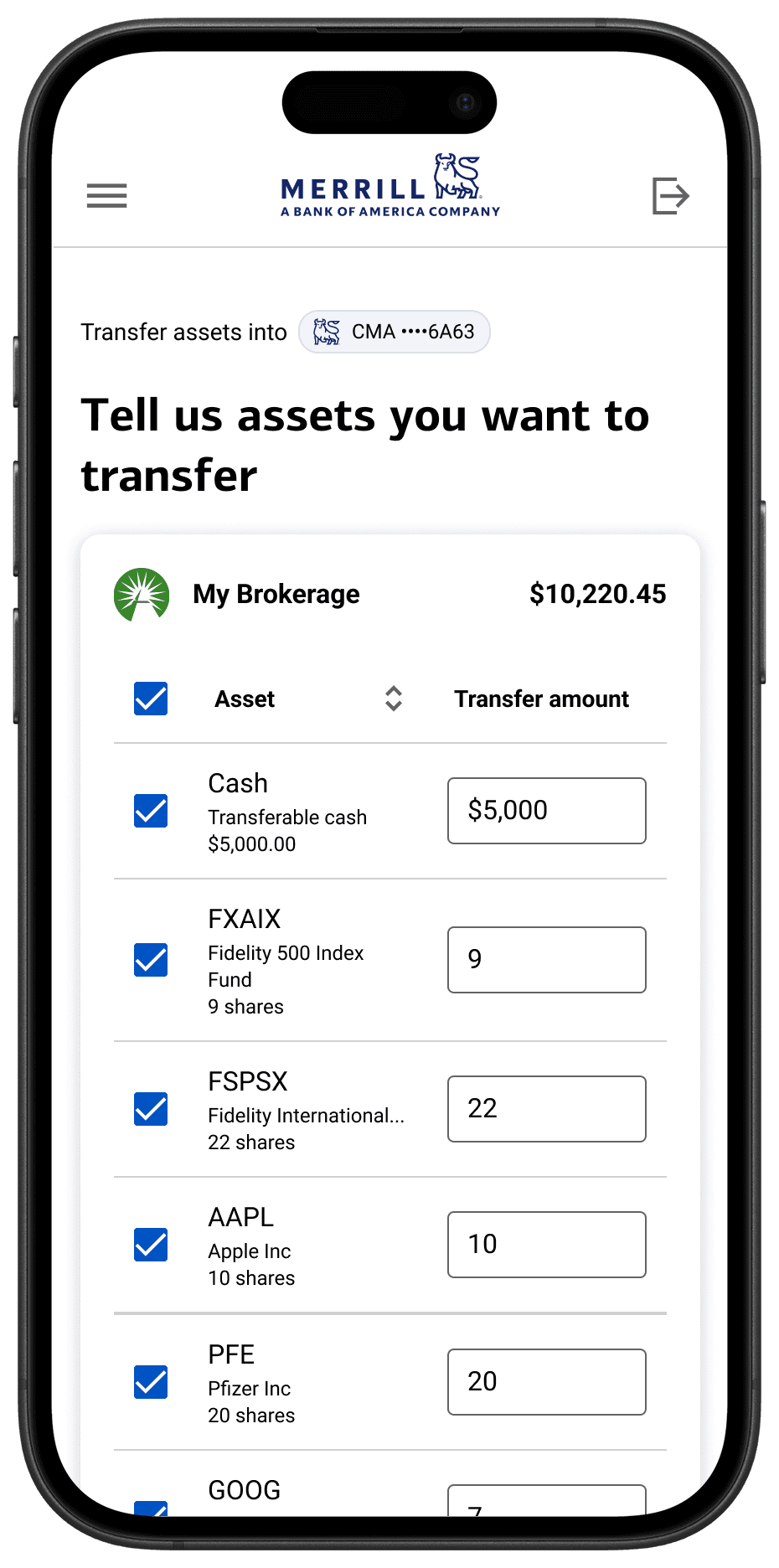
I leveraged a data table to organize and support dense financial information – asset name, ticker, selection status, checkbox selector, and input transfer amount. This also worked well for screen reader accessibility and for large and small breakpoints (Figure 3.0).
Lastly, full transfers were the most common type, so preselecting assets on page-load reduced the work required for a full transfer while preserving the flexibility to make a partial one.

04 – The Constraint
Handling clients with large transfers
The API backend imposed a limit on asset selection – clients exceeding 50 securities could only transfer their entire account or only up to 50 securities individually. However, if a client's external account holds ineligible assets, such as cryptocurrency or proprietary funds, then clients with over 50 securities were forced to make a partial transfer. I created tailored experiences for both (Figure 4.0, 4.1).
In addition, full transfers were the most common type, so preselecting assets on page-load reduced the work required for a full transfer while preserving the flexibility to make a partial one.


Adding an
Interstitial
While I explored other design solution, a radio question fulfilled the requirement without requiring the clients to understand underlying rules and complexity.
Two Paths
An asset counter made the selection limit visible, while contextual messaging explained when clients needed to change their selections and why.
Tailored Asset Selection
Choose a full transfer would take clients right to the last screen, while a partial transfer would allow clients to choose up to 50 securities.
Starting with what we already knew
I leveraged a data table to organize and support dense financial information – asset name, ticker, selection status, checkbox selector, and input transfer amount.
Tables also worked well for screen reader accessibility and for large and small breakpoints. Full transfers were the most common type, so preselecting assets on page-load reduced the work required for a full transfer while preserving the flexibility to make a partial one.
AI Experiments
Scaling design through AI, systems, and people.
At Bank of America, I'm currently building with AI, leading our Figma AI Enablement training, and mentoring other designers on best practices, tooling, and efficiencies.
Designers empowered
Mentored and supported in their professional growth.
Learning sessions
Advancing design capabilities and AI adoption across the organization.
Hunter is an exceptional design leader and educator. His learning and development sessions have raised design skills across the organization.

Natasha McMichael
Digital Exectuive @ Bank of America
Hunter demonstrates leadership with a diverse range of stakeholders. He is the most sought-after and productive member of the team.

Hunter Priester
Design Director @ Wells Fargo
Hunter serves as a model of what a great designer on our team is able to achieve. He worked smart and efficiently to deliver months ahead of schedule.

Nate Ernst
Senior Design Principal, Bank of America